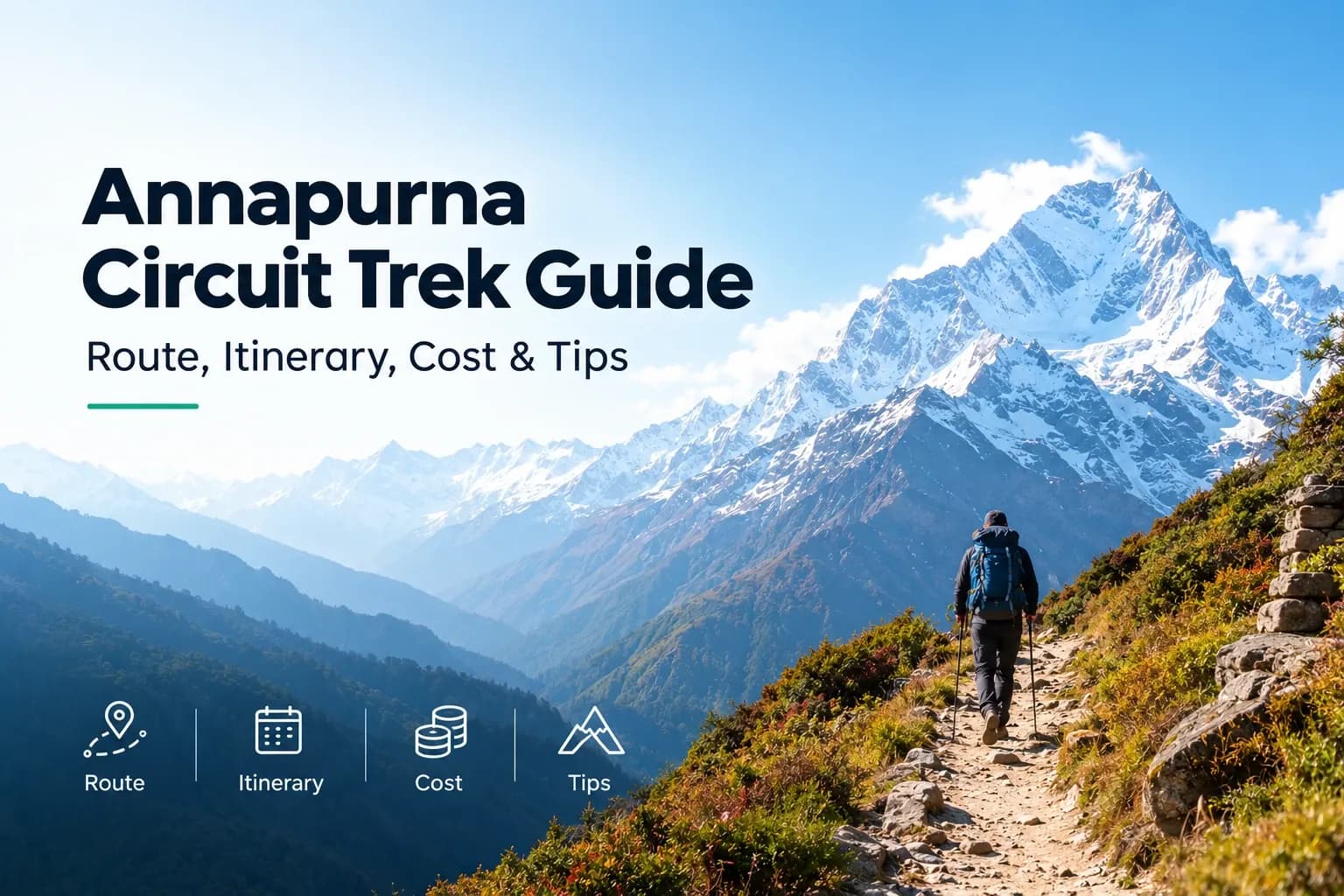
Annapurna Circuit Trek Guide: Route, Itinerary, Cost & Tips
Key Takeaways & Guide Summary
Quick Summary : 1. The Annapurna Circuit Trek is a classic Himalayan journey through Nepal’s diverse landscapes and mountain communities. 2. The comp...
- Verified Advice: Authentic trail insights by licensed guide Kumar Dahal.
- Seasonal Safety: Altitude awareness, weather windows, and pack lists.
- Permits & Rules: TIMS cards and National Park regulations covered.
- Direct Support: Free personalized route consultations available.
Quick Summary :
1. The Annapurna Circuit Trek is a classic Himalayan journey through Nepal’s diverse landscapes and mountain communities.
2. The complete trekking experience generally takes 20 days, depending on transportation, acclimatization, and side trips.
3. Thorong La Pass is the highest point of the route at 5,416 metres (17,769 feet).
4. The trek takes you through the Marsyangdi Valley, Manang, Muktinath, Mustang, and the Kali Gandaki Valley.
5. March–May and October–November are the recommended trekking seasons in the supplied guide.
6. The trek is moderate to challenging, with altitude and long walking days being major difficulties.
7. Teahouses and local lodges provide accommodation along the main trekking route.
8. The package starts at USD 1,306.25 per person for the 20-day itinerary, according to the supplied content.
9. Trekkers can experience Gurung, Manangi, Tibetan-influenced, and Thakali cultures along the route.
10. Custom itineraries can include Tilicho Lake, Poon Hill, private guides, or group trekking options.
The Annapurna Circuit Trek is a complete Himalayan journey around the Annapurna massif, travelling from Nepal’s green, subtropical valleys through traditional mountain villages and high alpine terrain before crossing the dramatic 5,416 m Thorong La Pass. It is not simply a walk from one village to another; it is a gradual passage through changing landscapes, cultures, climates, and ways of life.
Unlike a trek focused on reaching one base camp, the Annapurna Circuit gives you an entire story: river valleys, terraced farms, pine forests, Buddhist monasteries, high mountain passes, sacred pilgrimage sites, Mustang’s desert-like landscapes, and the immense Kali Gandaki Valley. Nepal Tourism Board describes the route as one of the country’s most diverse trekking experiences, extending from forested middle mountains to high Himalayan and trans-Himalayan desert landscapes.

What is the Annapurna Circuit trek?
The Annapurna Circuit Trek is a long-distance trekking route in central Nepal that traditionally circles the Annapurna mountain range. The route generally begins around Besisahar or Bhulbhule, follows the Marsyangdi Valley northward, reaches Manang, crosses Thorong La at 5,416 m, and descends through Muktinath and Mustang toward the Kali Gandaki Valley and Pokhara.
The classic route passes through:
- Besisahar and the lower Marsyangdi Valley.
- Dharapani and Chame.
- Pisang and Manang.
- Yak Kharka and Thorung Phedi.
- Thorong La Pass.
- Muktinath and Kagbeni.
- Jomsom and Marpha.
- Tatopani, Ghorepani, and Poon Hill.
- Ghandruk and Pokhara.
The complete experience generally takes 20 days, depending on transport, acclimatization, side trips, and the amount of the original trail you want to walk. Modern road access has shortened some lower and western sections, but the high-altitude core remains a demanding and rewarding walking journey.
The route is normally completed counterclockwise because the Marsyangdi Valley provides a more gradual approach to the high altitude before the Thorong La crossing. On the western side, trekkers descend into the dry Kali Gandaki Valley, which lies between Annapurna and Dhaulagiri with two of the world’s 8,000 m peaks.trade.
Who is this Annapurna Circuit trek for?
The Annapurna Circuit is suitable for travelers who want more than a short Himalayan viewpoint trek. It is ideal for people who enjoy physical challenge, cultural immersion, changing scenery, and the satisfaction of completing a long route.
It is a good choice for
- First-time high-altitude trekkers who are reasonably fit and prepared.
- Experienced hikers looking for a classic Himalayan route.
- Travelers who want to experience several landscapes in one journey.
- Photographers interested in mountains, villages, rivers, monasteries, and changing light.
- Cultural travelers who want to meet Gurung, Manangi, Tibetan-influenced, and Thakali communities.
- Adventure travelers who want to cross a high Himalayan pass without technical mountaineering.
- Visitors who prefer teahouse trekking rather than camping.
- People who appreciate a flexible journey involving both walking and local road transport.
You do not need to be a professional mountaineer. The trek normally requires no ropes, crampons, or advanced climbing skills in ordinary conditions. However, you need the endurance to walk for several hours on consecutive days and the judgment to respond properly to altitude and weather.
It may not be suitable for
- Travelers unwilling to walk uphill and downhill for long periods.
- People who want luxury accommodation throughout the route.
- Visitors with no flexibility for delays or itinerary changes.
- Trekkers who want to rush through the circuit without acclimatization.
- Anyone with a medical condition that could be worsened by high altitude without prior medical advice.
The biggest challenge is not only physical fitness. Thorong La reaches 5,416 m, and altitude affects people unpredictably. A strong athlete can still develop altitude sickness, while a slower and well-acclimatized trekker may cross safely.
Why choose Annapurna Circuit Trek?
One trek, many worlds
The Annapurna Circuit compresses an extraordinary range of Nepal into a single journey. You begin among green valleys, terraced fields, waterfalls, and subtropical forests. As the route rises, the vegetation changes to pine, fir, juniper, and alpine pasture. Beyond Manang, the land becomes drier and more open, eventually resembling the Tibetan Plateau.
Few Himalayan treks offer such a clear transformation from lush farmland to high-altitude desert within the same route. That progression makes the trek feel like a journey across several countries rather than one trail.
The achievement of Thorong La
Crossing Thorong La is the defining achievement of the circuit. The pass is not a technical summit, but reaching it requires patience, acclimatization, early-morning effort, and careful pacing.
The experience usually begins before sunrise at Thorung Phedi or High Camp. The trail climbs over rocky and sometimes snowy ground while the surrounding peaks gradually brighten. At the pass, prayer flags move in the wind and the enormous landscape opens in every direction.
The emotional reward is not just the altitude shown on the sign. It is the knowledge that you have crossed from the Marsyangdi side into Mustang under your own strength.
A living cultural journey
The Annapurna Circuit passes through communities rather than isolated mountain camps. Villages have their own architecture, food, religious traditions, festivals, and relationships with the landscape.
You may encounter:
- Gurung villages in the lower and central sections.
- Manangi communities around Manang.
- Tibetan Buddhist influence in the upper Marsyangdi Valley.
- Thakali culture in the Kali Gandaki Valley.
- Hindu and Buddhist pilgrimage traditions in Muktinath.
- Monasteries, chortens, mani walls, prayer wheels, and prayer flags.
This cultural dimension makes the route more meaningful than a simple mountain sightseeing trip. You are not only looking at the Himalayas; you are moving through communities that have adapted to them for generations.
Mustang’s otherworldly landscapes
After Thorong La, the scenery changes dramatically. Around Muktinath, Kagbeni, Jomsom, and Marpha, the mountains become dry, layered, wind-shaped, and desert-like.
The Kali Gandaki Valley is particularly striking. The valley runs between Annapurna I and Dhaulagiri and is known for its dramatic depth and powerful winds. Villages such as Kagbeni and Marpha add ancient stone architecture, narrow alleys, monasteries, apple orchards, and distinctive Thakali hospitality to the landscape.
A journey that can be personalized
The circuit can be adapted to different travel styles:
- A 14–16-day itinerary for travelers using road transport on less scenic sections.
- A 17–20-day itinerary for a slower and more immersive experience.
- A route with Tilicho Lake for an additional high-altitude adventure.
- A route including Poon Hill for sunrise views of the Annapurna and Dhaulagiri ranges.
- A private guided trek for maximum flexibility.
- A group trek for companionship and shared costs.
This flexibility makes the circuit suitable for both first-time Himalayan trekkers and experienced hikers. Customized Your Trip
What does the Annapurna Circuit trek feel like?
The Annapurna Circuit is a trek of contrasts. It can feel peaceful in a pine forest, intense on a high pass, deeply human in a village dining room, and almost unreal in the dry landscapes of Mustang.
In the lower valleys
The journey begins with sound and movement: rivers, birds, suspension bridges, farmers, mule trains, terraced fields, and waterfalls. The air is warmer, the villages are greener, and daily life is visible around every bend. You may feel that the mountains are still distant but each day they rise closer.
Around Manang
Near Manang, the atmosphere becomes quieter and more spacious. The air is thinner, the mountains feel larger, and the villages appear more adapted to altitude.
This is where the trek becomes a personal test. You must slow down, rest properly, drink enough, and accept that progress is measured in careful steps rather than speed.
On Thorong La
The past day often combines excitement, discomfort, uncertainty, and pride. The cold air, steep trail, fatigue, and altitude demand concentration. You may feel your breathing become harder and your pace become slower.
Then the pass arrives. The prayer flags, surrounding ridges, snow, and vast sky create a moment that stays in memory long after the trek ends.
In Mustang and the Kali Gandaki Valley
The descent brings relief, but not monotony. The air becomes warmer, the vegetation changes again, and the landscape develops a completely different character.
The dry cliffs, ancient villages, monasteries, apple orchards, and strong valley winds make the western side feel like another world. The journey gradually returns from high alpine terrain to forests, hot springs, and green hills.
Why travelers remember it
People remember the Annapurna Circuit because it creates a strong sense of movement and transformation.
You do not simply arrive at a viewpoint by vehicle, take photographs, and leave. You earn each change in scenery through days of walking. Your body experiences the steep climbs, cold mornings, tired feet, thin air, warm meals, and gradual descent.
The trek can make you feel:
- Small beneath the scale of the Himalayas.
- Proud after crossing Thorong La.
- Connected to local communities through shared meals and village stays.
- Be more patient because high altitude forces you to move slowly.
- Surprised by how quickly landscapes can change.
- Grateful for simple comforts such as hot tea, dry clothes, and a comfortable bed.
- Refreshed by the distance from traffic, screens, and ordinary routines.
Its appeal is not only the mountains. It is the personal transformation that takes place while moving through them.
Why Book the Nepal Tour Guide Team for the Annapurna Circuit Trek?
A guided Annapurna Circuit Trek is more than simply following a trail. With an experienced local team, you get professional support, local knowledge, and a more comfortable trekking experience from Kathmandu to the Himalayan trails. Nepal Tour Guide Team has more than 10 years of experience providing trekking and travel services, with experienced and licensed guides who understand Nepal’s mountains, culture, and local communities.
A professional guide can assist you with:
- Experienced Local Guides
- Safety and Altitude Awareness
- Route and Itinerary Support
- Local Knowledge
- Personalized Trekking Experience
- Communication and Local Support
- Emergency Assistance
- Responsible Tourism
With Tour Guide in Nepal Team, you are not only hiring a guide, you are traveling with a local team that combines trekking experience, safety awareness, cultural knowledge, and personalized service to make your Annapurna Circuit Trek safer, smoother, and more memorable.
Quick Facts of the Annapurna Circuit Trek
Category
Practical information
Region
Annapurna Conservation Area, central Nepal
Classic direction
Counterclockwise, from the Marsyangdi Valley toward Thorong La
Highest point
Thorong La Pass, 5,416 m
Typical duration
20 days, depending on road transport and side trips
Walking difficulty
Moderate to challenging; altitude is the main difficulty
Technical climbing
Not normally required
Accommodation
Teahouses and local lodges
Main gateway
Kathmandu, then Besisahar or Bhulbhule
Main exit points
Muktinath, Jomsom, Tatopani, Nayapul, and Pokhara
Best seasons
March – May and October – November
Core attractions
Manang, Upper Pisang, Thorong La, Muktinath, Kagbeni, Marpha, Tatopani, Ghorepani, and Poon Hill
What is the cost for the Annapurna Circuit Trek cost
The Annapurna Circuit Trek cost depends on the services included, group size, accommodation, transportation, and the level of comfort you choose. In our Tour Guide in Nepal, we offer a well-organized Annapurna Circuit Trek package that covers the essential services required for a safe and enjoyable trekking experience.
Latest Blog : Annapurna Circuit Trek Cost Complete Cost Budget & Price Breakdown
Our Essential services for the Annapurna Circuit Trek are given in the table below :
Category
Details & Breakdown
Pricing & Cost
Starting Price : USD 1,306.25 per person (for the 20-day itinerary)
Cost Factors : Varies based on preferred transportation, group size, itinerary customization, and additional services.
What's Included
Airport pickup and drop-off 3-star hotel accommodation in Kathmandu with breakfast Teahouse accommodation during the trekMeals as specified in the itineraryExperienced English-speaking trekking guide & porter service
Local transportation
Annapurna Conservation Area (ACAP) and TIMS permits
Complete food, accommodation, salary, equipment, and insurance for guides and porters
What's Excluded
International airfare and Nepal visa fees
Travel insurance
Personal expenses (laundry, internet, hot showers)
Alcoholic and cold drinks
Trekking equipment (sleeping bag, down jacket)
Tips and emergency helicopter evacuation costs
Trip Customization & Styles
Options available for budget-friendly treks, comfortable standard treks, or customized private adventures.
Itineraries and services can be fully adjusted to match specific requirements, budgets, and travel preferences.
If you are planning your Annapurna Circuit adventure, Contact us for the latest price and a customized trekking package.
Quick Summary Itinerary for the Annapurna Circuit Trek
Here is the 20-day itinerary extracted from the Tour Guide in Nepal page, presented in a clean table. The itinerary begins in Kathmandu, crosses Thorong La at 5,416 m, and ends with departure from Kathmandu.
Day
Route / Activity
Elevation
Duration / Notes
1
Arrive in Kathmandu
—
Airport pickup, half-day Kathmandu heritage sightseeing, trek preparation, hotel overnight
2
Kathmandu - Besisahar - Khudi
790 m
6–7 hours’ drive, then about 1 hour’s trek; first views of the Manaslu range
3
Besisahar - Sirung
2,200 m
6–7 hours; suspension bridges, waterfalls, rice paddies, subtropical forest, Tamang settlement of Taranche
4
Sirung - Jagat
1,290 m
Relatively easy trail through woodland, villages, temples, and bridges over Sangu Khola and the Marsyangdi River
5
Jagat - Dharapani
1,920 m
Forest, cliffs, riverbanks, Tal, waterfalls, and rugged trail to Dharapani
6
Dharapani - Chame
2,630 m
Forested ridges, Manang District headquarters, views of Lamjung Himal, Annapurna II and IV, plus a hot spring
7
Chame - Upper/Lower Pisang
3,190 m
Steepest part of the Marsyangdi Valley; views of Paungda Danda and the widening valley
8
Pisang - Manang
3,520 m
Upper Pisang route via Geru; mountain views, changing dry landscape, and Barge Monastery
9
Rest day in Manang
3,520 m
Acclimatization; short hike to Bhojo Gumba or Gangapurna Lake; optional visit to Vraga Village and Himalayan Rescue Association
10
Manang - Ledar
4,250 m
Gradual ascent through Tenki and the Jarsang Khola Valley
11
Ledar - Thorung Phedi / High Camp
4,500 m
River crossing, climb to Phedi; overnight at High Camp around 4,600 m
12
Thorung Phedi - Thorong La - Muktinath
5,416 m pass; 3,800 m Muktinath
About 4 hours’ climb to the pass, then descent to Muktinath; prayer flags, chortens, and pilgrimage site
13
Muktinath - Kagbeni - Jomsom - Marpha
2,665 m
Visit Vishnu Temple and Gompa; descend through Kagbeni and Jomsom; Kali Gandaki Valley and Tibetan-like landscape
14
Marpha - Kalopani
2,530 m
5–6 hours; Thakali villages, views of Dhaulagiri, Tukuche, Nilgiri, Fang, and Annapurna I
15
Kalopani - Tatopani
1,160 m
Mostly downhill; subtropical forest, Rupse Chahara waterfall, Dana, Narchyang Besi, and hot-spring bath
16
Tatopani - Ghorepani
2,775 m
Climb through Ghar Khola Valley, Shikha, Chitre, terraced farmland, and rhododendron forest
17
Ghorepani - Poon Hill - Tadapani
3,210 m Poon Hill; 2,700 m Tadapani
Early sunrise hike to Poon Hill; return to Ghorepani for breakfast, then trek east through rhododendron forest
18
Tadapani - Ghandruk - Nayapul - Pokhara
827 m Pokhara
5–6 hours’ trek plus about 1 hour’s drive; Gurung village, views of Fishtail, Annapurna South, and Hiunchuli
19
Pokhara - Kathmandu
1,400 m
5–6 hours’ drive; souvenir shopping and farewell dinner
20
Final departure from Kathmandu
—
Airport transfer approximately 3 hours before the scheduled flight
Frequently Asked Question
1. How long does the Annapurna Circuit Trek take?
The Annapurna Circuit Trek typically takes around 20 days, including arrival in Kathmandu, trekking, transportation, acclimatization, and departure. Shorter 14–16-day itineraries are possible with road transport on selected sections.
2. What is the cost of the Annapurna Circuit Trek?
According to the supplied package details, the 20-day Annapurna Circuit Trek starts at USD 1,306.25 per person. The final cost depends on group size, transportation, accommodation, itinerary, and additional services.
3. What is the highest point of the Annapurna Circuit Trek?
Thorong La Pass is the highest point of the Annapurna Circuit Trek, reaching 5,416 metres (17,769 feet) above sea level.
4. Is the Annapurna Circuit Trek difficult?
The trek is considered moderate to challenging, mainly because of long walking days, steep ascents and descents, and high altitude. Good physical fitness, gradual acclimatization, and careful pacing are important.
5. What is the best time to do the Annapurna Circuit Trek?
The best seasons are generally March to May and October to November. These periods are popular for trekking, although actual trail conditions and weather can vary.
6. Do I need mountaineering experience for the Annapurna Circuit Trek?
No, technical mountaineering experience is not normally required in ordinary conditions. However, trekkers need sufficient endurance, preparation, and awareness of high-altitude risks.
7. What accommodation is available during the Annapurna Circuit Trek?
The route primarily offers teahouses and local lodges. The package described in the article also includes three-star hotel accommodation in Kathmandu with breakfast.
8. What is included in the Annapurna Circuit Trek package?
The listed package includes airport transfers, Kathmandu hotel accommodation, trekking accommodation, specified meals, an English-speaking guide, porter service, local transportation, ACAP and TIMS permits, and guide and porter expenses.
9. What expenses are excluded from the Annapurna Circuit Trek package?
Exclusions include international airfare, Nepal visa fees, travel insurance, personal expenses, alcoholic and cold drinks, trekking equipment, tips, and emergency helicopter evacuation costs.
10. Can I customize my Annapurna Circuit Trek itinerary?
Yes. You can choose a shorter or longer itinerary, include Tilicho Lake or Poon Hill, or select a private guided trek or group departure according to your preferences, schedule, and budget.
Our TripAdvisor review :Tour Guide in Nepal
Content Reviewed By
Nepal Tour Guide Team Trek & Expedition Pvt. Ltd.
A licensed trekking and tour operator in Nepal, specializing in unforgettable Himalayan adventures across the Everest, Annapurna, Langtang, and Manaslu regions. Led by experienced local guides, we create safe, personalized, and responsible trekking experiences with expert knowledge of Nepal’s mountains, culture, and trail conditions.
Legal document :Tour Guide in Nepal


Kumar Dahal
Verified Lead GuideGovt. Mountain Guide License No. 2097/073 • Founder of Nepal Tour Guide Team
Kumar Dahal has over 20 years of active high-altitude guiding across Everest, Annapurna, Manaslu, and Langtang. Born in the Himalayan foothills, he specializes in personalized route planning, altitude safety protocols, and authentic cultural immersion for international travelers.
Add Tour Guide in Nepal as Preferred Source on Google
Stay ahead with verified Himalayan trail conditions, permit updates, and authentic Nepal travel guides directly in your Google Search & AI Overviews.
Recent Travel Articles & Guides

Top 3 Wildlife Explorations In Nepal You Shouldn't Miss
Imagine this: the steamy jungle air thick with exotic scents, the calls of unseen creatures echoing through the trees, and...
Rafting Adventure Trips: Calling all Adventure Seekers ♀️
Hey there, awesome friends! Today, let's chat about something super co...
Romance in the Mountains: Valentine’s Day with a Nepal Tour
Welcome to Romantic Holidays in Nepal tour. Embark on an unforgetful journey! Wanting to explore a new destination with the love of your life? So here you go.
